

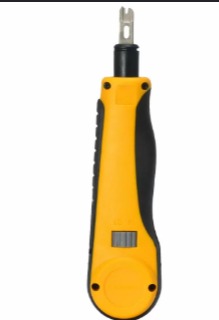
Description
Item Description: Impact Punch Down Tool (with Reversible Blade) An Impact Punch Down Tool (also known as a telecom or network termination tool) is a specialized hand tool used by network technicians and IT professionals to install copper wiring into network jacks, patch panels, and surface mount boxes. The tool utilizes an internal spring-loaded impact mechanism. When downward pressure is applied to the tool handle, the internal spring compresses until it reaches a release threshold. It then unleashes a quick, powerful mechanical strike that forces the wire deep into an Insulation-Displacement Connector (IDC) slot. This action cuts through the wire’s plastic insulation to establish a clean electrical connection while simultaneously trimming off the excess wire with the integrated cutting edge of the blade. Key Features: Impact Adjustment Wheel: Features “Hi” and “Lo” impact settings to accommodate different wire gauges or fragile hardware housings. Reversible Blade Mechanism: The tool accepts twist-and-lock blades that feature a termination-only edge on one side and a termination-with-cut edge on the opposite side. Integrated Pick and Spudger: Many bodies include fold-out hooks to assist in pulling wires out of jacks or scraping away debris. Compatible Mechanisms & Hardware Terminations An impact tool does not work on standard screw-terminal blocks. It is engineered specifically to interface with matching IDC (Insulation Displacement Connector) Blocks, including: 1. 110-Block Architecture 110 Keystone Jacks: The standard RJ45 modular jacks used in wall outlets for Ethernet connections (Cat5e, Cat6, Cat6A). 110 Patch Panels: Centralized termination hubs inside server racks and data closets where office network lines converge. 110 Wiring Blocks: Commonly used in structured data distribution frames for high-density voice and data routing. 2. 66-Block Architecture (Telecom) 66 Punch Down Blocks: The legacy standard used widely in analog telephone systems, PBX networks, and commercial voice lines. (Requires swapping in a 66-type blade). 3. Specialty Systems (Dependent on Blade Model) Krone Blocks: A proprietary European design often found in older telecommunication distribution centers. BIX Blocks: High-density termination systems prominent in enterprise voice setups. Compatible Wire Types The mechanical slots on the blades and the impact forces are strictly calibrated for solid core networking wires: Solid Copper Wire: Optimally handles 22 AWG to 26 AWG solid conductor twisted-pair cabling. Network Standards: Used to terminate Cat3, Cat5, Cat5e, Cat6, and Cat6A cables. ⚠️ Note: This mechanism is not compatible with stranded wire (like the kind inside pre-made patch cords). Stranded wires will fray or slide out of IDC slots, resulting in a failed or intermittent network connection.
Reviews
There are no reviews yet.